- Winner
- Case competition
- Mobile
Introduction
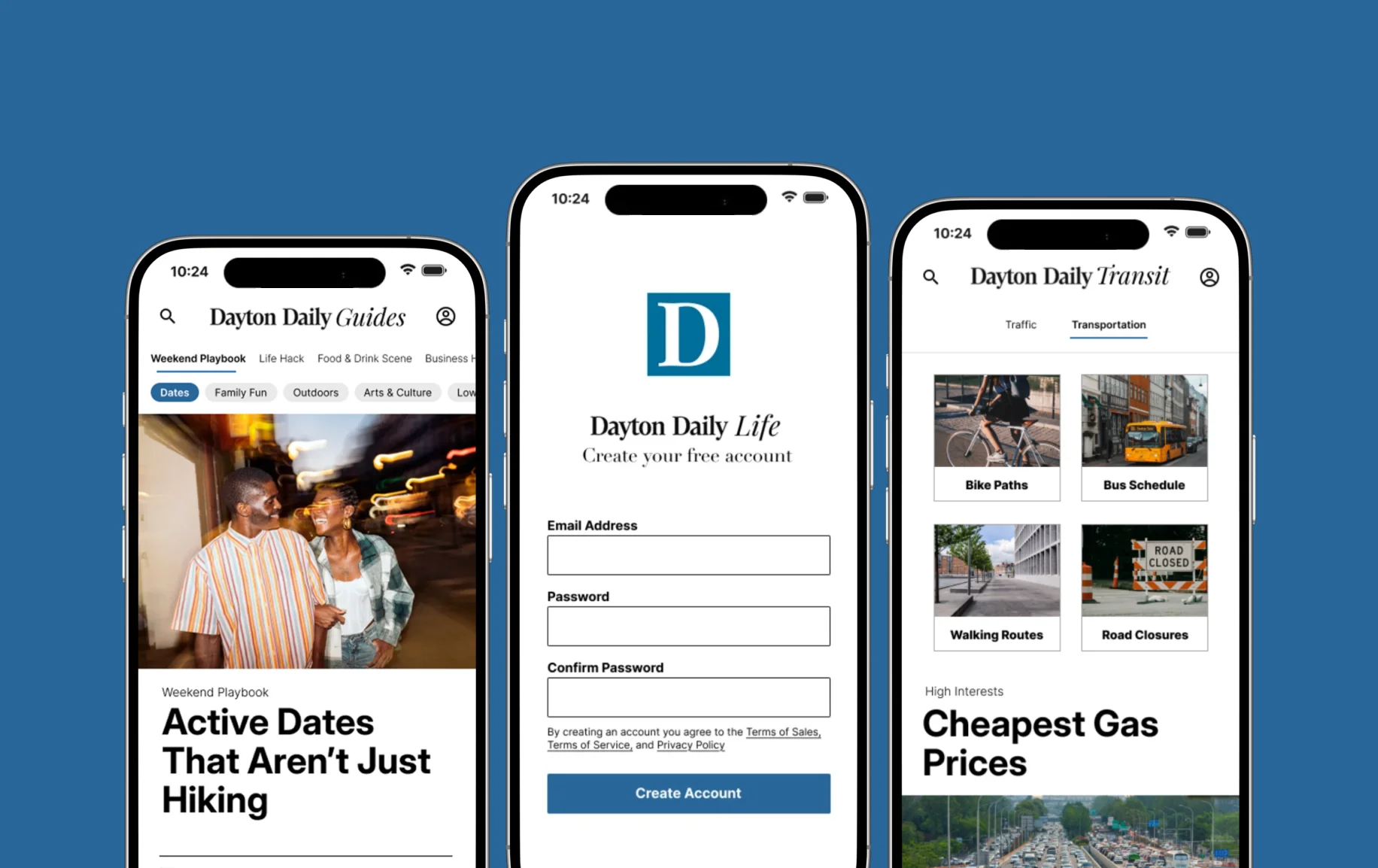
I designed the core screens of the Figma prototype for Dayton Daily Life, an all-in-one app that adds city guides, podcasts, transit, and a community forum to a local newspaper. Our team of four won the Cox Enterprise Case Competition among ~20 teams (Sept–Oct 2025). Judges said we clearly captured the market and the problem, connected our solution to Cox’s other businesses, and landed on a podcast direction they were interested in.
Student concept, not affiliated with Dayton Daily News or Cox Enterprise.
What is Dayton Daily News?
The Dayton Daily News (DDN) is the daily newspaper of Dayton, Ohio, and part of Cox Enterprises’ portfolio. It delivers print to most of Montgomery and Miami counties and parts of Greene County, and sells digital access and home delivery.
Today’s Product
A website and ePaper, a daily Morning Briefing newsletter, and subscriber-only games and puzzles.
Its Strength
Our interviewees called it trustworthy, and one said it is the first result when she searches for Dayton news.
Its Challenge
Print readership is shrinking, the paper is ending its Saturday print edition, and it has little pull with younger readers.
Problem
Grow a pro-print paper that is losing subscribers
DDN is losing subscribers and engagement, as legacy print is. The client is pro-print, so dropping the paper was not an option. The brief asked us to size the market, propose a cost-effective growth strategy, and use Cox’s other businesses.
- 01Size the market
- 02Propose a cost-effective growth strategy
- 03Use Cox’s other businesses
My Role
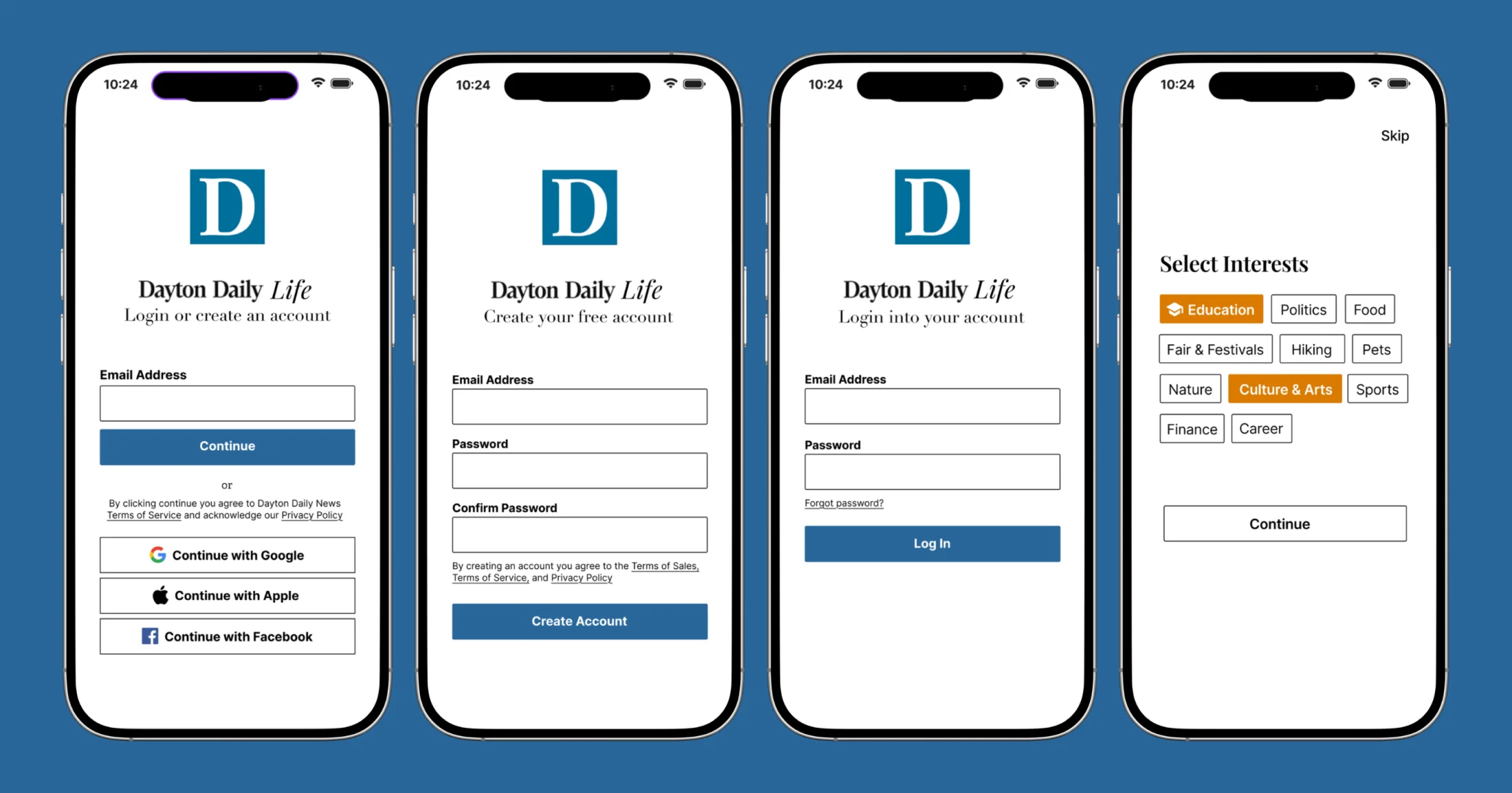
I owned the Guides concept. In Figma I designed the onboarding flow (sign-in, login, register, interest selection) and the News, Guides, and Transit screens. A teammate designed Podcasts and Community. I also contributed to the interviews and helped with the market sizing.
Research
We interviewed 5 Dayton residents
and presented 3 personas in our deck
From those conversations we built three personas spanning DDN’s current and future readers:
Relationship to News
- TV news
- Print news when he can find it
- Would use phone if he had to; more comfortable with paper
Thoughts on DDN
- Reads DDN every day
- Purchases it from a news stand
- Trustworthy
Dayton Culture
- “Big small town”
- Small city charm, holding onto tradition (like paper news)
Relationship to News
- Daily emails of news summary
- Primarily digital on phone
Wants
- More content, less ads
- Things to do in town with his wife
- Updates on local sports teams
- Traffic updates + highway closures
- Misses local radio and discussion of local issues in the car
Dayton Culture
- Small big city
- Transient: people coming and going (Air Force Base, colleges)
Thoughts on DDN
- Good source of information; first result on searches
- Sees DDN content on her social media reel
- Active in the comments
- Wants an online forum for Dayton discussion
Dayton Culture
- Large suburbs with diverse people
- Active population (e.g. school board elections)
- Downtown is coming back as the city invests in places to hang out
- Many people move away but come back to settle
Industry data pointed the same way: only 4% of Americans prefer print news, and the digital segment is the one growing (Pew, Statista).
Key decisions
Grow new readers, don't convert print readers
Print is part of Dayton’s identity, and the growth was in people DDN wasn’t reaching. We targeted 25–40-year-olds with an all-in-one app that opens on familiar DDN news, then adds four tabs: Guides, Podcasts, Transit, and Community.
Design - Guides + onboarding
Guides turns DDN's local trust into a daily-use tool
98% of residents search online for local businesses and services, and 75% worry about fake reviews (BrightLocal, 2025).
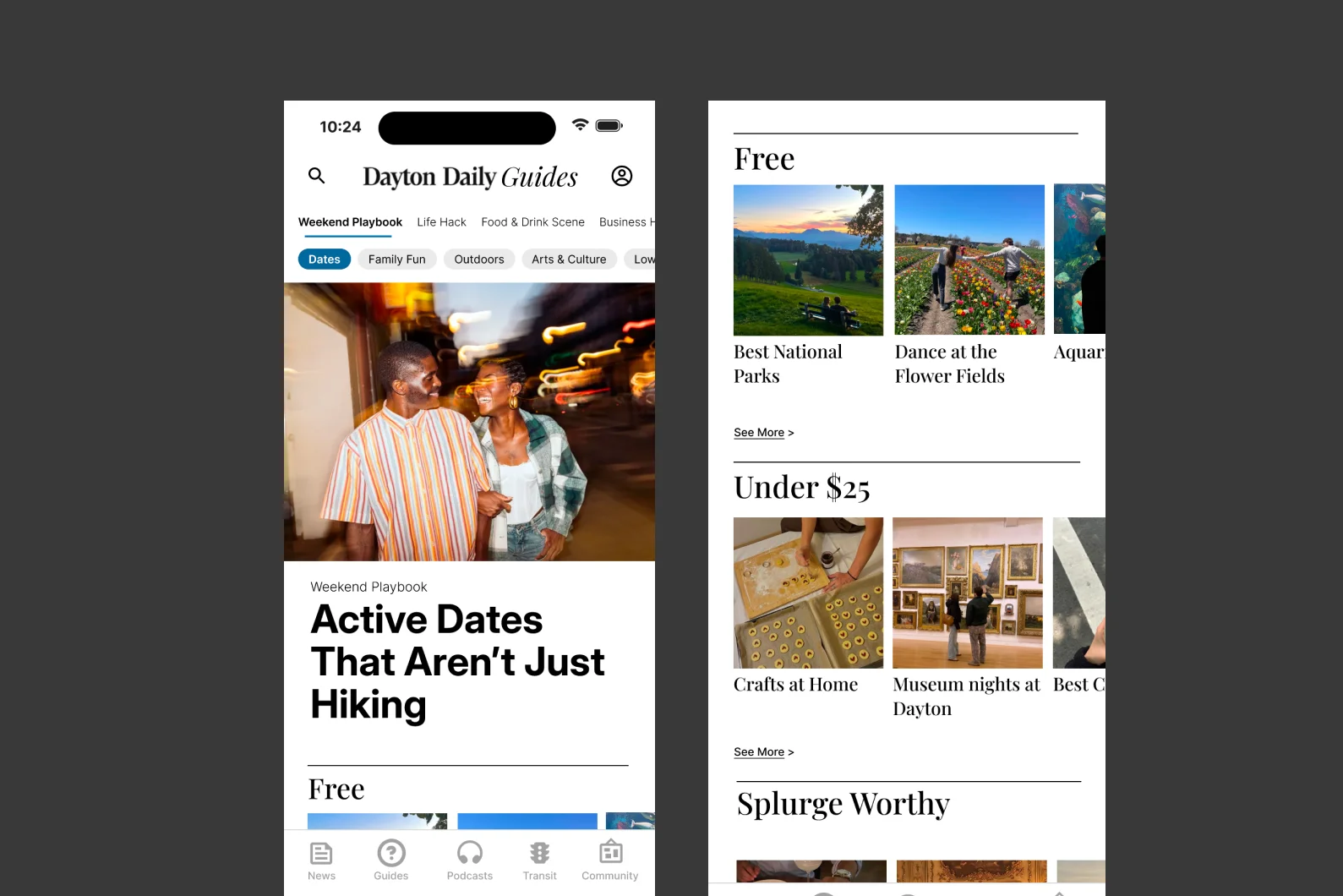
- Top TabsChipsDatesFamily FunOutdoorsArts & Culture
Structure
Top tabs mirror what interviewees wanted to do. Chips narrow within each tab.
- FreeUnder $25Splurge Worthy
Budget Tiers
Sections are grouped as Free, Under $25, and Splurge Worthy.
Onboarding
A Select Interests screen personalizes the feed after sign-up, with a Skip option so it never blocks entry. Social sign-in (Google, Apple, Facebook) keeps registration short.
Design - Transit
Two tabs built on data that already exists
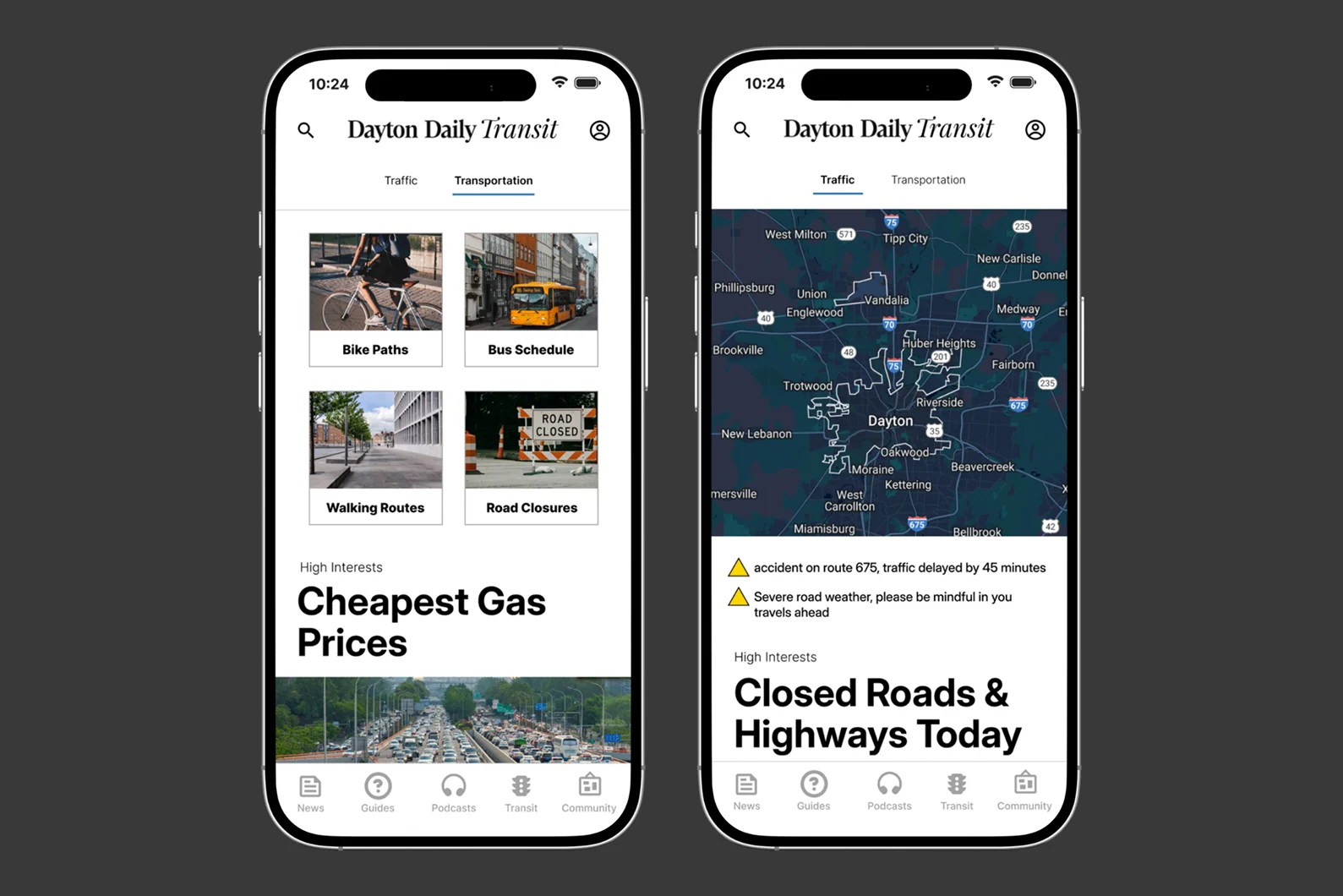
Transit has two tabs. Traffic shows a live map and incident alerts. Transportation covers bike paths, bus schedule, walking routes, road closures, and cheapest gas. It relies on data that already exists from ODOT OHGO, GDRTA, and AAA, so it is buildable.
Outcome
We won among ~20 teams. The judges said we clearly captured the market and the problem, tied our solution to Cox’s other companies, and landed on a podcast direction they were already interested in.
Reflection
What I’d do differently
- 01
Rethink Transit
Traffic came up often in interviews, but live traffic is a utility, not news. I would test whether commuters come back for it, and tie alerts to local reporting.
- 02
Add a localized news view
People value hyper-local coverage, so a page organized by neighborhood or city would strengthen the core product.
- 03
Prototype the paywall and test with real users
We did not prototype how Guides would be gated, and we did not test with 25–40-year-olds. I would do both before building.